Microscopic view of scientific research
Our Technology

Patented Thin-Skin
Microcapsule Technology

Flexible, permeable nano-thin skins formed by in-situ precipitation of amphiphilic macromolecules — delivering active ingredients exactly where and when they're needed.


Core Innovation

How Our Microcapsules Work

Capsulent's patented thin-skin microcapsules selectively bind to damaged areas, then release biopolymer under tensile force to seal and repair — like a molecular zipper.

Nano-Thin Flexible Skins

Unlike traditional thick-walled capsules, our nano-thin flexible skins are formed by in-situ precipitation of amphiphilic macromolecules around active ingredient droplets. A range of wall chemistries are possible, but most of our products use inexpensive, plant-derived materials already in common use as personal care ingredients.

The result is a capsule that can be engineered to release its payload on contact with the target surface, upon mechanical shear, or in a controlled manner over extended time periods. Our proprietary thin-skin microcapsules carry payloads of greater than 99% — much higher than competitive encapsulation technologies.

Discuss Your Application
Capsulent microcapsule cross-section diagram showing core and charged-complex shell
Key Properties

What Makes Our Capsules Different

Every aspect of our microcapsule technology has been optimized for personal care applications.

Nano-Thin Flexible Walls

Ultra-thin skins that flex without breaking, surviving mechanical stress during formulation and application.

Selective Binding

Capsules that target damaged or specific areas — binding selectively where treatment is needed most.

Permeable & Tunable

Release profiles can be engineered — from instant burst on contact to slow, sustained delivery over hours.

Plant-Derived Materials

Made from inexpensive, plant-derived biopolymers already in common use as personal care ingredients.

Mass-Market Pricing

Our manufacturing process keeps costs low, making advanced encapsulation accessible for consumer products at scale.

Formulation Compatible

Integrates seamlessly into existing personal care formulations — lotions, serums, shampoos and more.

Robustness

Built to Survive Real-World Processing

Capsulent microcapsules are robust to a wide variety of conditions and compatible with most consumer product formulation and processing.

pH Stable: 2 – 12

Capsule walls are unaffected across nearly the entire pH range, from strongly acidic to strongly alkaline formulations.

Temperature Resistant

Capsules withstand freeze-thaw cycles up to 80 °C processing without wall integrity loss.

Shear & Surfactant Stable

Capsules survive mixing, pumping shear and surfactant exposure. Compatible with both cationic and anionic formulations.

>99% Payload Capacity

Our thin-skin design maximizes the active-ingredient-to-wall ratio, carrying payloads far higher than traditional encapsulation methods.

Note: While microcapsules are compatible with both cationic and anionic formulations, very high ionic strengths can affect wall stability. The permeable walls of controlled-release products can be subject to leaching by high solvent content.
Encapsulate Types

Oil-in-Water & Water-in-Oil Systems

Capsulent offers both oil-miscible and water-miscible encapsulate systems to accommodate a wide range of active ingredients and product formats.

Oil-in-Water

Oil-Miscible Actives in Aqueous Carrier

Encapsulated oils and oil-miscible materials provided as a slurry in an aqueous carrier. Suitable for direct dilution into aqueous formulations.

Applications: Shampoos, conditioners, body washes, lotion bases, serums, sunscreens and spray repellents.

Water-in-Oil

Water-Miscible Actives in Non-Aqueous Carrier

Encapsulated water-miscible materials provided as a slurry in a non-aqueous carrier. Suitable for direct addition into oil-based products or dispersion into aqueous formulations.

Applications: Probiotic formulations, ethanol sanitizers, antibacterial handwashes, oil-based serums and balms.

Comparison

Capsulent vs. Traditional Encapsulation

Property Capsulent Thin-Skin Traditional Thick-Wall
Wall Thickness Nano-thin (<100nm) Thick (microns)
Flexibility Highly flexible Rigid, brittle
Selective Binding Targets damaged areas Non-specific
Release Profile Tunable (burst to sustained) Typically burst-only
Formulation Compatibility Seamless integration Limited compatibility
Materials Plant-derived biopolymers Often synthetic
Payload Capacity >99% active ingredient Typically 30–70%
pH Stability Stable pH 2–12 Narrow pH range
Cost Mass-market accessible Premium pricing
A+ Technology

A+ (Aloe & Alginate) Formula

Beyond microcapsules, Capsulent's A+ formula is a breakthrough aloe-alginate delivery system with unique physical properties.

Overhead view of aloe vera plant — the plant-derived foundation of Capsulent's A+ formula

Plant-Powered Delivery

A+ is built on two natural ingredients: Aloe Barbadensis Leaf Juice Powder and Algin (sodium alginate from brown seaweed). Together, they form a transparent, sprayable gel matrix that is inherently anti-inflammatory and soothing.

Available in three product forms — Powder, Gel, and Beads — A+ adapts to virtually any application format, from fine mist sprays to leave-on treatments. Compatible across a pH range of 4–8.

Transparent & Invisible

A+ produces a visually clear formula that won't alter the appearance, color, or texture of your finished product.

Fully Sprayable

A+ is completely sprayable and ideal for pump, mist, or spray applications — perfect for after-shave, body mists and leave-on treatments.

Shear-Thinning

A+ exhibits shear-thinning behavior — it flows easily when rubbed or sprayed but holds its structure at rest, enabling versatile application formats.

Anti-Inflammatory & Soothing

The aloe-alginate base provides built-in anti-inflammatory and soothing properties, making A+ ideal for sensitive skin and post-procedure care.

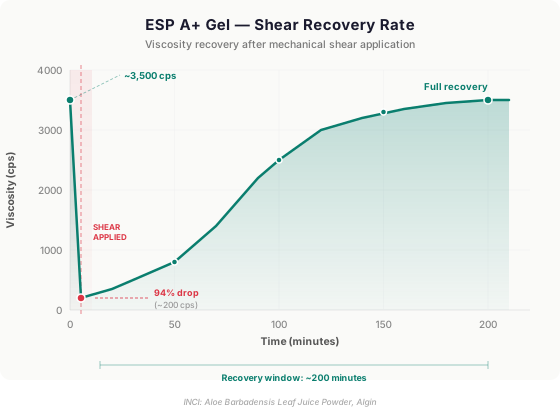
ESP A+ Gel Shear Recovery Rate graph showing 94% viscosity drop under shear with full recovery over 200 minutes

A+ gel recovers its full viscosity (~3,500 cps) within approximately 200 minutes after a 94% shear-induced drop — demonstrating exceptional structural resilience.

Want to See How This Applies to Your Product?

Schedule a technical consultation with our team to explore how our encapsulation technology can solve your formulation challenges.

Book a Technical Consultation